Showing posts with label travelogue. Show all posts

Wednesday, June 2, 2010

The majesty of Angkor Wat

Photos from our trip to Siem Reap, Cambodia in December of 2006.

The main reason for going to Siem Reap was to visit the Angkor Wat complex.

angkor_temple_complex

Like many of the breath taking structures that are awe inspiring because of size and span, the Angkor complex is preceded by a long approach. Likely this is so that you can take in the atmosphere and surroundings as you approach

angkor2006_ outercomplex_wall

One indicator of economic disparity was the shutter click quotient. While tourists carried multiple ways to take pictures, the locals made use of the local photographer to take a single picture to mark the memorable visit.

angkor2006_ portrait_photo

Dancers in costume waiting to be photographed with Angkor Wat in the background. While I suspect this was more a tourist trap by intent, I did not see any takers during our time there.

angkor2006_ dancers

The long corridors of the outer walls are filled end to end with Ramayana and Mahabharata etchings, as well as many other stories that I did not recognize. This is one of Hanuman

angkor2006_ hanuman

Statue heads on the outer walls lining the ramparts outside the complex

angkor2006_ gatefigures

Walking up and down these ramparts were these magnificent elephants. It was clear that the mahouts handling the elephants had a relationship with them. They were so comfortable and caring as they handled the beasts while they waited to ply riders up to the hilltemple adjacent to the main Angkor complex

angkor2006_ mshouts

Tuesday, June 1, 2010

Jogyakarta travelogue: English lessons at Borobudur

December 20, 2009.

mumbai_jogya 304

I have always found people more fascinating than buildings. There are those (like my wife) who can spend days and weeks, sometimes even their entire lives, tracking down the hidden stories and clues that buildings offer us. Me? I prefer to watch the man making his monkey do tricks at the entrance of the Red Fort.

So it is a small surprise that I was only mildly enthused about visiting Borobudur during our Jogyakarta/Bali trip. Scoff if you must, and call me a philistine. After all, Borobudur is one of the hidden treasures of the world. Remind me that I said the same thing when we were first driving towards Angkor Wat during our December 2006 trip to Cambodia. The reality is that I was not excited about going to see this magnificent Mahayana Buddhist monument.

Even with this mild discontent, it is difficult to conceal that first moment when the vantage point opens up. The close to 1/2 mile long walk leading up to the majestic monument allows you to take in the enormity of the project, let it sink in slowly. And sink in it did. I was pleased that this was a perambulatory. It meant we would have to climb. At least there would be movement.

We traversed the first set of stairs and sat in the first level enclosure. As we did, three girls with a notebook approached us and asked us if they could speak to us. Being well trained South Asians with a suspicion for all strangers in big places, we tersely said no and walked away. As I sat and watched, I noticed that small clusters of kids were approaching tourists and foreigners as they came up that first set of stairs. It seemed like they were having a conversation.

I was curious.

When a group of six school girls approached us on the second level, I didn't shoo them away.

"Hello Mister, are you busy?"
"No".
"We are from xxxx school and we would like to practice English with you."
(I slowly started to understand but was still cautious)
"Sure."
The girl beamed and her friends quickly gathered. They pulled out a notebook and began to read out their practice questions.
"What is your name?"
"What is your favorite color?"
"How old are you?"

I tried to get my daughter to answer. She preferred to watch curiously.
I was waiting for a sell at some point during the conversation.
It never came.

After an enjoyable few minutes, the kids said thank you and left.

I was delighted.

kids-borabadur2

We walked around taking in the myriad seated Buddha statues, many of which were decapitated

decao-buddhabb

When the next group of kids showed up I was much more relaxed. I asked them questions back. Turns out the teachers in the local schools had discovered a novel way to get their kids to practice spoken English. Go mix with the natives. So they did these field trips to Borobudur and Prambanan, walked up to total strangers, and asked them questions in English.

Some kids had a ringleader. The rest would observe and nod. I tried a couple of times to make them all talk. Most of the kids had cameras, and wanted to take a picture of us. We said no the first couple of times but then realized they were going to show it to their teacher, and started saying yes. Soon we started taking pictures of the kids.

The most striking thing was how alive they were. I suppose all kids are. They are a constant rejuvenation wherever I go. No doubt their lives were not easy. But there, on that day, they were kids again, running around together, having fun doing a school assignment.

kids-borabadur1

Clothed in burkas, totally modest and polite, they exhibited a childish joy when the shutter click moment came, flashing their peace signs.

As I took my Borobudur pictures, I found they sprang to life when I included the visitors. Even though it is believed that the temple was abandoned when the Javanese converted to Islam and the Hindu and Buddhist Kingdoms died out, it was clear that these modern Muslims still held a great curiousity and interest in the monument.

mumbai_jogya 331

I did two more English lessons that day. The last one was with a group of college kids. They ran over to us as I was waiting for my wife and daughter to return from a bathroom trip. The kids were smart, friendly and enthusiastic. It was clear they were Gen Y'ers. Everybody flashed their cell phones, and all grinned when I asked if they were on FaceBook.

"Of course!"

They told me that a fluent English speaker earned 25% more in a white collar job than a non-fluent speaker. The problem was that they had little opportunity to practice. This idea of practicing with tourists was recent. Had I more time, I would have loved to go and spend a few days at their college or school and just sit and talk to these kids. Perhaps they were practicing their English with me, but I was learning so much from them.

By the time I left the premises, I was sated. I had taken in one of the historical wonders of the world, and had spent time with the ones that would carry the future of this planet.

All in all, a good day.

Friday, May 14, 2010

Bali travels - Child labor on Amed beach


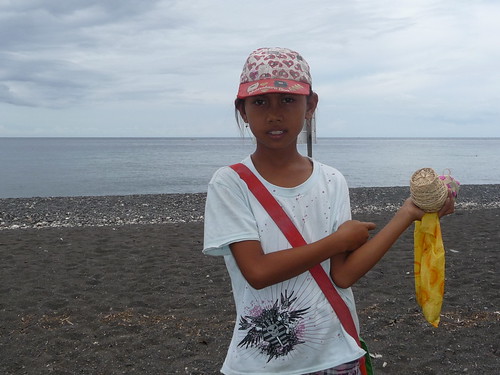
Her name is Wayan. I met her wandering the beaches in Amed, the Northern part of Bali famous for its scuba diving and snorkeling. If you've visited Bali you know the name is common, given there are only four first names in all of Bali.

She was the oldest (hence Wayan). She spoke good English. She was smart; shrewd even. Her story was good, and she was focused on selling her little boxes of salt. The hapless Australian pair who were sunbathing at the Cafe where we were, paid 50,000 Rupiah for a small wicker box of salt. She offered it to me for 10,000. Perhaps a good neighbour discount?

The conversation went something like this.
Me: How much did they pay for it?
Wayan: 50,000 Rupiah
Me: (with a smile) really?
Wayan: (with a catious smile) yes
Me:Who makes this?
Wayan: My mother makes the boxes. I did the shell design on the top. I collect the salt
Me: Do you go to school?
Wayan: Yes.
Me: Good
Wayan: I will give this to you for 10,000. Do you want to buy?

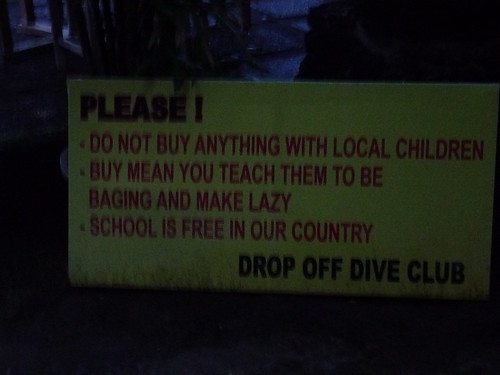
It made me smile. It was decent US rates. Roughly $1 for a wicker basket with sea salt in it. The Balinese price would be closer to $1000 rupiah. I didn't buy from her. After eating a sumptuous seafood meal at the Amed Restaurant, I saw a sign in broken English that was clearly for the benefit of the tourists.


It didn't shock me as such. After all, it is the same sentiment in India. We all feel very strongly that child labor should be abolished. Yet in different ways we have all made use of it, perhaps guiltily, because it suited us and improved our quality of life. From the perspective of those below the poverty line, living from hand to mouth, it was a matter of survival not morals or ethics. The notion of a child's quality of life was an unreachable sentiment to those parents.

I felt the familiar pangs of guilt as I walked the 600 yards back to the luxurious Kembali Beach Bungalow, a small resort run by a Dutch immigrant who now called Bali his home. I want to help, but I know that there is likely some 'bossman' who is collecting most of the profit the kids make. It's the same rackets as the streets of Mumbai.


I spoke to one of the workers there a little later. Ketut, who was a local, was starting to speak to me a little more. Now that we had been there for two days, I asked him questions about Amed and Bali in general, and about his life in particular. This topic was clearly close to his heart as he was quick to respond.

The signs he told me, were put up by the people that started the scuba diving shops on Amed beach. They were not local. They were Javanese, but not from Bali, and definitely not from Amed. Because of weather conditions, the sea faring folk could not make salt and sell it in quantity. So on a given day, if they do not catch any fish, they go hungry.

'How can they judge?' He asked me somewhat angrily. 'They don't provide employment for the adults. They underpay and take advantage. Then they put up signs that we should not buy from the children.'

I did not have an answer. Standing there in that picture perfect part of the world, I felt his sadness and helplessness.

I went home that day and hugged my little girl. It alleviated the heaviness in my heart about Wayan's prospects for the future.

The next day, we bought some beads from Wayan.