Friday, May 21, 2010

Dancing for my dad


I read a great post by little boxes which prompted this. I will continue to call her Rhea till there's reason not to. Reading it made me think of my daughter, who is studying Bharatanatyam.

I say studying but perhaps I should say my daughter is being made to study Bharatanatyam. She is seven years old. It is the parents dilemma between listening to what the child says about what her interests are and deciding for her that it is important for her to have a skill or discipline. This of course is summarily complicated by the fact that she is an only child, which leaves more time than is healthy more likely for ruminations by said parents on this topic.

My father started me on percussion lessons when I was five years old. I loved drums from much younger than that, so it was a welcome addition to my life. I took mridangam lessons for three and a half years. At the tender age of nine, I decided I did not want to take classes with my teacher anymore. I still remember that on the day I decided I wanted to stop classes, it was because my mridangam class coincided with a movie my family was going to see. In order to go see the movie, I told my father I wanted to stop lessons.

In hindsight, it was a loss. Not the teacher; he was very loseable. I mean the opportunity to have classical training and to advance my skills. My father didn't question my decision. In fact he gave me the money for the lessons already taken and let me tell my teacher that lessons were over. I remember that to this day. On the one hand my father was giving me autonomy. On the other, perhaps I was allowed to make this decision earlier than I was able to.

So now when my daughter tells me she doesn't want to go to class, I bribe her. I figure my job is to get her to class; it is the responsibility of her teacher (who is wonderful) to draw her into the magical world of dance. Almost always this is the case. She is smiling when she comes out, sometimes skipping rhythms as she trots to the car. The enthusiasm wanes mid week and the cycle continues.


Our thought was that by learning Bharatanatyam she would have access to multiple things; Hinduism, mythology, music, movement, expression, and grace. By doing it in class, hopefully she would make some friends and gain the discipline that comes with the development of an art form.

The one thing she definitely likes to do is dress up. She loves the two hour process of makeup, costume and jewellery. For now, that is enough to make her go to class.

As she grows older, I see glimpses of it in her everyday life. A hasta while she brushes her teeth. Footwork while she walks down the hallway, done surreptitiously so as not to give parents any evidence that she might have absorbed anything from class.

Does she have to dance all her life? No. Percussion and drumming have stayed with me all my life.

If she gets discipline and a roadway into the vast mysteries of South Asian culture, I will consider it mission accomplished.

Thursday, May 20, 2010

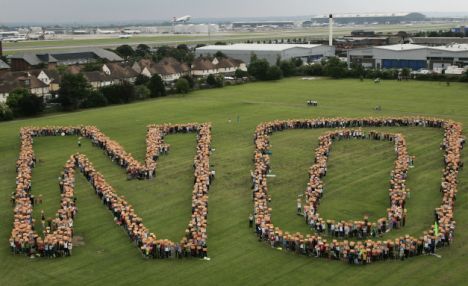
Just say no


I went to buy dog food for our JackChi yesterday. Her name is Sparkle, we've had her for three months and she's an amazing rescue dog. But this post is not about her. I bought her some Solid Gold Just a Wee Bit adult dog food. The one guy at the PetCo that seemed to know stuff about the products recommended it to me. It was also ok'd by our Vet neighbour Susie. You probably know him. He's the one that all the other employees call over when you ask them a question. But then again, I'm not writing about dogfood. Not today anyway.

I bought the big case and ambled to the counter. It was my luck that the manager was at the checkout counter. I think it was AP exam week and all his highschool worker bees must have taken the day off. I stood in line and watched as he did three cross sells and then closed by finally asking the lady in front of me if she wanted to donate $5 today to the dog cancer society.

Now, don't get me wrong. I am very much in favor of science and research. I also like to help people and do what I can for the environment. I just do not like being pressed into it.

It gave me great pleasure therefore to stand there and say a curt 'No' or 'No thanks not today' for each cross sell and the $5 donation.

As I walked out, I felt a calmness and contentment. It was a comfort in the belated realization that when I said worked extra hard to please people I didn't know, the end result was that I would walk away feeling slightly cheapened or deeply irritated. Being a consensus builder and agreeable are great traits; I value them both. I also know now that I don't need to exercise them all the time.

There was this guy Bob. A balding African American man that showed up at the game room at Haverford College to play ping pong. I always beat him, altho he played well. I would subsequently spend 30 - 45 minutes listening to him talk. About any topic of his choice. I just did not know how to say 'sorry Bob, have to go' and walk away'.

I went into a RadioShack when I was 14, to look at radios. We looked at a model and the salesman sold himself to me. I didn't realize this till later. While it was more expensive than I would have liked and not what I wanted, I fought with my father about it because I didn't want to let the salesman down.

The problem was that this was the result of perfectly good middle class values and a community upbringing. When you are taught every day to think about other people and do more for others, it is then a confusing thing (at least for me) to throw those ingrained values out the door the moment you were talking to a stranger or a vendor. I think part of this is that I did not develop a strong notion of an inner, middle and outer circle of loyalty.

So how did I learn to start saying no? The good news is that after life pounds the decency out of you and beats you down to a pulp, you start to realize the need for self protection. The awareness comes slowly and you hold it close to your heart and look around surreptitiously, checking to see who else saw it delivered. There's this guilt you have to overcome about abandoning childhood values. You can circumvent this by saying that this is a more sophisticated treatment of those same values.

The conversion comes the very first time you use it. You say it.
No.
It's foreign. Scary even.
What's even more frightening is the feeling afterwards. The relief, the load off your shoulders. The unwanted responsibility now turned into a polite, yet diffident negation.

Why in the world did I not do this before?

That was my general refrain once I started swinging the No hammer.

Bang
Bang
Bang

Damn, does it feel good.

Friday, May 14, 2010

Bali travels - Child labor on Amed beach


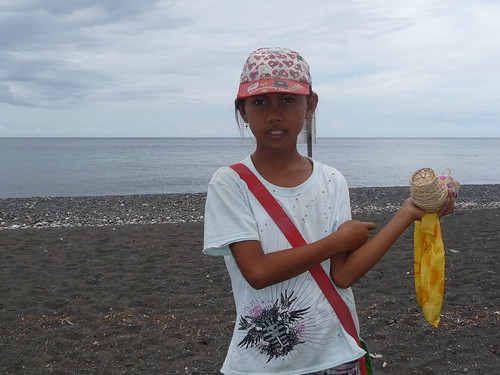
Her name is Wayan. I met her wandering the beaches in Amed, the Northern part of Bali famous for its scuba diving and snorkeling. If you've visited Bali you know the name is common, given there are only four first names in all of Bali.

She was the oldest (hence Wayan). She spoke good English. She was smart; shrewd even. Her story was good, and she was focused on selling her little boxes of salt. The hapless Australian pair who were sunbathing at the Cafe where we were, paid 50,000 Rupiah for a small wicker box of salt. She offered it to me for 10,000. Perhaps a good neighbour discount?

The conversation went something like this.
Me: How much did they pay for it?
Wayan: 50,000 Rupiah
Me: (with a smile) really?
Wayan: (with a catious smile) yes
Me:Who makes this?
Wayan: My mother makes the boxes. I did the shell design on the top. I collect the salt
Me: Do you go to school?
Wayan: Yes.
Me: Good
Wayan: I will give this to you for 10,000. Do you want to buy?

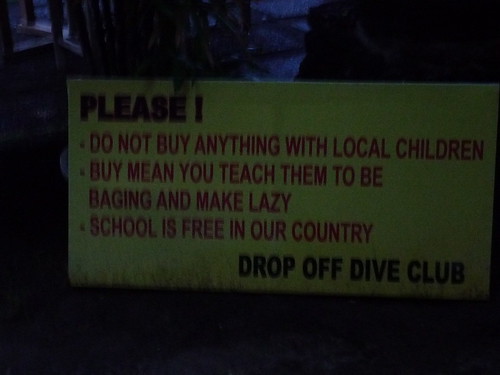
It made me smile. It was decent US rates. Roughly $1 for a wicker basket with sea salt in it. The Balinese price would be closer to $1000 rupiah. I didn't buy from her. After eating a sumptuous seafood meal at the Amed Restaurant, I saw a sign in broken English that was clearly for the benefit of the tourists.


It didn't shock me as such. After all, it is the same sentiment in India. We all feel very strongly that child labor should be abolished. Yet in different ways we have all made use of it, perhaps guiltily, because it suited us and improved our quality of life. From the perspective of those below the poverty line, living from hand to mouth, it was a matter of survival not morals or ethics. The notion of a child's quality of life was an unreachable sentiment to those parents.

I felt the familiar pangs of guilt as I walked the 600 yards back to the luxurious Kembali Beach Bungalow, a small resort run by a Dutch immigrant who now called Bali his home. I want to help, but I know that there is likely some 'bossman' who is collecting most of the profit the kids make. It's the same rackets as the streets of Mumbai.


I spoke to one of the workers there a little later. Ketut, who was a local, was starting to speak to me a little more. Now that we had been there for two days, I asked him questions about Amed and Bali in general, and about his life in particular. This topic was clearly close to his heart as he was quick to respond.

The signs he told me, were put up by the people that started the scuba diving shops on Amed beach. They were not local. They were Javanese, but not from Bali, and definitely not from Amed. Because of weather conditions, the sea faring folk could not make salt and sell it in quantity. So on a given day, if they do not catch any fish, they go hungry.

'How can they judge?' He asked me somewhat angrily. 'They don't provide employment for the adults. They underpay and take advantage. Then they put up signs that we should not buy from the children.'

I did not have an answer. Standing there in that picture perfect part of the world, I felt his sadness and helplessness.

I went home that day and hugged my little girl. It alleviated the heaviness in my heart about Wayan's prospects for the future.

The next day, we bought some beads from Wayan.

Saturday, March 13, 2010

Vignettes of Sri Lanka: Who took my cricket ball?

Ravi woke up with a start and looked around. Daylight had barely broken, and it was an unusual, but interesting feeling to be awake. He looked with a hidden pride at his new watch to see what time it was. Not many of his friends had digital watches. This one had the most basic of functions: the time, an alarm, and a beeper for the hour. Some of his other friends had stop watches, and even a calculator. But this was good enough for now.

He quickly went through his morning routine, put on the clean white shirt mom had washed and ironed for him, along with the blue shorts black socks and black shoes that completed the uniform for school. It would be two years before he was in 8th grade, at which point the boys were required to wear long white pants instead of the shorts he now threw on everyday. He absently wondered how some of his classmates' parents were going to have the money to buy those new clothes. He knew many that had exactly one shirt and one pair of shorts for school. There were people like Murugesh (who everybody called Murukku) who endured constant humiliation because he wore his Bata rubber slippers to school - simply because he didn't own any shoes.

He quickly slurped down the half boiled egg. The slimy texture was interesting as it coated his throat and slithered into his aesophagus. He needed strength today, and he needed to get to school quickly.

'Amma, school pohiren'
'Mom, going to school'

He put his lunch box into his satchel and hurried out the door answering 'yes' 'yes' 'yes' to all his mom's usual queries.

'Thambi, do you have your lunch'
'Are you taking the bus'
'Remember to come home early so Appa can take you to practice'

It was sort of interesting and exciting to be out and going to school alone. It was only recently that he had started doing this. He didn't like to remember the trauma of being caned by his school principal for being late. After all, why was it his fault if his dad was delivering a baby and couldn't drop him off in time? 'He shouldn't have just caned the boys who came in cars' he muttered to himself. He increased his walk to a slow trot to try and push that out of his mind. As he did, he thought about the fact that it had catalyzed the permission to walk to school or take the bus. His parents wouldn't have agreed if that hadn't happened.

He walked out on the big pavement on the main road. Reaching down, he patted his pocket to make sure that the two 25 cent coins were there. His eyes darted down the road to see if the 103 was in sight. The public TATA bus was better. First, because it only cost 25 cents, and second because it took him right up to the school. The private buses were smaller, more crowded, charged 50 cents, and turned off before his school stop.

But the thing is that they were so much more frequent.

Today he wasn't going to try and save 25 cents for an ice palam at school. He needed to get to school. He turned around to look at the big block of flats behind him. Naren and his brother lived there. Everybody at school called Naren 'nondi'. Cruel, because he had polio at an early age, and one of his legs was irreversibly damaged. Naren was a survivor though, so he never let any of these comments get to him. It was unlikely that he or his brother would be on the bus. They took the general school bus that came by. That's what most of the boys used to come to school. He frowned slightly as he looked at his watch again. It was 6:50, which meant it would be 7:05 before he got to school, and class started at 7:30. Just as he started to worry, the familiar frame of the 103 bus appeared on the horizon.

He silently congratulated himself as he jumped on. He paid the 25 cents and hovered close to the exit. He never liked to sit. It was kind of fun to stand and see if he could balance when the turns were made. Sometimes he would hold on with one hand. He never tried what some of his friends did, which was to let go. His bag was a little clunky and he knew he would go flying if he tried that. He always remembered the words of his current teacher in school.

'They don't call us para Demalayas (Damn Tamils) for nothing. If you're too scared to stand up and fight, then you better learn to get around quietly.'

Thinking about that always sobered him. He knew that the Sinhalese boys made trouble, and he always wondered why they as a class never retaliated. The class above them somehow was more together. Their Sinhala classmates never bothered them. But it was hard to tell what it was. This got him thinking about his own classmates. He was thinking about each one of them and their characteristics as he routinely got off at his stop and walked to school. As he hit the gates, he came back to the moment with a start. He looked at down at his watch to see the digits staring back at him. 7:05. Instead of going to class he ran to the field, reaching inside his satchel to pull out the tennis ball as he motored. He and Sashi were batting today, and if he wasn't there by 7:10 then they were automatically out. It wasn't often that he got a chance to get in a good partnership. Usually they put him in the tail end. Not necessarily because some of the others were better than him, but they were bigger and more persistent.

He made it in time. The wickets were set up - two bricks set about a 24" width apart. The other team was mostly there, and his classmates were waiting. He quickly grabbed a bat and surrendered his tennis ball. Wellington, the captain walked up and grabbed him by the elbow 'We need runs, but singles and doubles ok? No heroics. Don't whack the ball around. Try not to get out and let Sashi score the runs' Naren was there, in his usual position as head umpire. Who knows where he would have been in the batting order if he wasn't a nondi?

Ravi nodded a quiet assent.

He did well, and listened. As he watched, played some cautious front foot strokes, and played a few down the line, exhibiting a straight bat, he could see Wellington and some of the others nodding. Around them other groups of other cricket matches had welled up. There were no teachers in sight. This was their time. They figured things out amongst themselves on the field.

And then it came.

A badly pitched ball down the leg side. It was fast, but not too fast, bounced about midway down the pitch and just hung there. It happened often because the bowlers often forgot that he was lefty and would bowl as though he was right handed. He pulled at it and made contact. The ball soared through the air and flew away. It was easily going to be a boundary.

Damn it.

His heart froze. He looked over apologetically at Wellington, who was then the leg umpire. He got icy stares all around, from his team, as well as the other team. Wellington jogged past him and smacked him sharply on the head. 'Finished'. He said curtly. As a whole, the group of players moved in the direction of the ball. If they were lucky, there was a bunch of Tamil boys playing in the direction the ball went in. Today however, his luck had run out with catching the 103 bus. No ball came flying back. They went towards the group and Wellington asked for the ball.

Blank stares.

Now the games would begin. The Sinhalese boys would hide the ball. They would throw it around amongst themselves. In the worst case scenario, they would pick a fight with one Tamil boy, and then then everybody on the field would gang up. Sadly, in those cases, the other Tamil boys would stand and watch, not wanting to be part of the massacre.

Today, it looked like it would be Bhavanathan. He was a scrapper, and usually lost his cool before everybody else. He'd call people names, and would the first one that got jostled around. He was in there being aggressive. Just then, his heart quickened. He saw Fernando.

Fernando was a Sinhalese Christian boy on the soccer team with him. It was the one place where he got to talk to and spend time with Sinhalese boys from school without being attacked. Their eyes met. He raised his head in a silent acknowledgement. Fernando responded. Strange how they talked and joked during practice, and tried to get out of the hard exercises together, and here they were on opposite camps.

Ravi stepped forward and put his hand on Bhavanathan's shoulder. It got brushed off. Bhavanathan didn't need him as an ally. Ignoring the rejection, Ravi spoke directly to Fernando.

'Machan, ball'
'Hey man (literally, cousin), ball'

Umbagethe?
Yours?

The familiar term in Sinhalese, connoting friendship or a connection.

A nod of relief

'Depang!'
Give it!

The word was barked out. Fernando wasn't the clan leader by any means so everybody was nervous to see him assert himself in this fashion. As we stood, there was a slow thaw. The tension broke. The tennis ball emerged slowly from behind somebody's back. Ravi smiled sheepishly and held his hand out.

'Malli, yanda'
'Little brother, go.'

The Sinhalese boy said it sarcastically and then threw the ball up in the air, in the direction of where they had set up their wicket and stumps. Everybody turned almost in unison and tore after the ball.

Usually, if the ball got taken like that, whoever hit it out there was automatically out, for wasting time. The irony of being out for scoring a boundary was never lost on him. But today, they let Ravi and Sashi bat for the remaining 3 minutes after the ball fiasco. This decision simultaneously evoked elation and nervousness. Elation that he was not out, that he would be batting at interval today; nervousness and anxiety at what had just happened, and the very real prospect of it happening again with each ball that was bowled to him.

The bell rang, and everybody started walking toward class. The tennis ball was returned to him and he put it back in his satchel. As he walked he felt his knees buckle under him. Somebody had just kicked him behind his kneecap. He started, and then stopped when he saw it was a grinning Fernando. On the soccer field, it was a common move that punished the unaware. Ravi regained his balance.

'Hey thanks machan'

'For the kick?'

'No you bugger. You know what I meant'

Fernando became serious again for an instant, then his eyes lightened. In Sinhalese he said

'You better buy me an ice palam at practice today.'

'Sure.'

Ravi watched as Fernando jogged to catch up with his classmates. With a certain heaviness he realized that Fernando had already gotten over the incident. After all, it's easy for the predator to be gracious in victory.

He patted the 25 cent coin in his pocket. Easy come easy go.

'At least I'm batting at lunch today'.

He went in and sat down and waited for class to begin.

Friday, March 12, 2010

Preparing a power-of-attorney in the US for use in India

We are buying a flat in Kolkata.

I guess it's good news. We have been trying for about six years and it has led to multiple false starts and eleventh hour slips. So much of it is that we have not ever really committed to spending a chunk of time in Kolkata where we focused on this.

We almost bought a flat in South City. But the documentation hassles that accompanied it were so ridiculous that we were relieved when our potential seller went off and sold it to somebody for a higher price.

But I digress.

The good news is that the paperwork and legal work around this flat is clearing up fast. The bad news is that it means we have to get a power of attorney generated. I'm documenting what I did here in the hopes that it will help others who are trying to do the same.

I first started off with the assumption that I'd have to go through the Indian Embassy. My visit to our local area Embassy website had a cryptic note that the Indian Embassy would not attest apostilled documents.

The text reads:
Embassy of India will not re-authenticate a public document that has been apostilled by the authorities of the country of origin.

The fact that the Indian Embassy website can use copy editing is a subject for another post. The power of attorney information is tucked away under the 'Miscellaneous Services' section. The miscellaneous services form has a checkbox for Power of Attorney, but they do not tell you that you have to write up the power of attorney letter or have it generated in India and that the miscellaneous services form is just a cover letter.

So, if you are an Indian citizen, or the document is generated in India and mailed to you, then go to this great blog post by Chandan on how he did this. His information is specific to doing it in California, but can be used to figure out how to do it in any state.

My situation is different, in that we are both US citizens, my wife being a PIO card holder. So in our situation, we wanted to give her sister-in-law the ability to act on our behalf for activites around the flat purchase. When I researched what Chandan did, I saw that it was possible to generate the power of attorney (POA) or general power of attorney (GPA) in the US and apostille it for use in India.

Here is the gist of what I found out.

As a result of India becoming a signatory to the Hague convention in 2007, any documents apostilled in the US for use in India are not required to be adjudicated in India. The California Indian Embassy site has a good explanation of this. What this means is that you can write a power of attourney here, and apostille it so that it can be used in India.

What's this apostille business you might ask. Good question.

An apostille is the stamp that one country puts on a document that legalizes it for use in the other country. It is done by the Authentication division of the Secretary of State office in your respective state. So just google secretary of state for your state and most states have very good info on what is required for the apostille process. Here's the information for North Carolina.

So here's what I did.

1. Googled the internet to find templates for a general power of attourney letter for use in India. You can find ones like this and this one from ICICI.

2. Modified it for our use (in our case, to allow all activities for buying a flat in India. If you are unsure about modifying just leave it as is. The general POA probably has more than what you need.

3. Sent it to our lawyer in India to verify.

4. Added one section that he wanted included

5. Copied the template into a word document.

6. IMPORTANT: Added the authentication text that is required by the Secretary of State office for a local notary. Be sure to include the right text. Your Secretary of State office will likely have the verbiage they want on the notarized document.

7. Got it notarized by a local notary with two witnesses. The two witnesses are to make it a valid POA in India.

8. Got the document apostilled by the Secretary of State office. I did it personally. Got it in by 10am and got it back by 4pm. But most offices have a process for mailing it in, and it takes about 3 - 4 days

9. Took the apostilled, notarized document and sent it DHL to India. Since it was apostilled, there was no need to adjudicate it in any way in India.
.


Hello world

Well here it is. My decision to start up a personal blog again and start writing has actually resulted in something. I started blogging many years ago, at Yahoo 360. It was a wonderful experience. I met a lot of fellow bloggers there who are still friends and people who I feel I know better than some real life friends of mine. It's because people talk in blogs, say things about whats going on. You have to blog to understand.

I have a blog at Sulekha. It's ok. The folks there are nice and all. The thing is that I do not want to write just for that community. Or perhaps its more that I am too tired to go make friends in just that group. The nice thing about Blogger and Wordpress is that they support open commenting. People don't have to have a Sulekha id to chime in. At the end of the day, isn't that the reason that one blogs rather than keeping notes in a nice leather journal?

It's the eternal quest for feedback.

Bloggers are egoists, I've heard say. I will agree with that. Wanting feedback is a double edged sword. Yet, over and over again, I find myself going online to find help for obscure things and find the best answers in some one helpful soul's post, where they describe in ways you can understand, how they got through this situation you are facing.

How do you get a power of attorney drawn up for use in India if you live in the US?
How do you apostille a document?
What's a Jack Russell Terrier/Chihuahua mix all about?

Now I've given away what my next three posts are likely to be, since this is what I've been dealing with the last few days.

So we will see. More than anything else, I wrote at Yahoo to get the demons out of my head. There's something very cathartic about putting things down into words. They killed 360, because it wasn't hip enough, and not popular enough. I didn't know at the time what a special online community it was.

So starts another journey. I wonder where it will lead.